Climate Change and the Economy of Bangladesh
Climate Change in Bangladesh have a significant impact on Bangladesh’s economy. Natural disasters can damage roads, bridges, agricultural fields, factories, homes, and other infrastructure. When severe floods or cyclones occur, businesses may temporarily close, transportation can be disrupted, and workers may lose income.
Agriculture is especiallyUse Content AI to optimise the Post. important because millions of people depend directly or indirectly on farming and fisheries. Climate-related disasters can reduce agricultural production and increase the cost of food and recovery.
The economic impact is not limited to immediate physical damage. Repeated disasters can reduce household savings, increase debt, interrupt children’s education,Climate Change in Bangladesh and make it harder for vulnerable families to improve their living standards.
Climate-Induced Migration in Bangladesh
Climate change can contribute to population displacement in Bangladesh. Flood river erosion, cyclones, coastal salinity, and loss of agricultural land can force families to move temporarily orClimate Change permanently.
Some people move to nearby towns,Climate Change in Bangladesh while others migrate to major urban centers such as Dhaka and Chattogram in search of employment and safer living conditions.
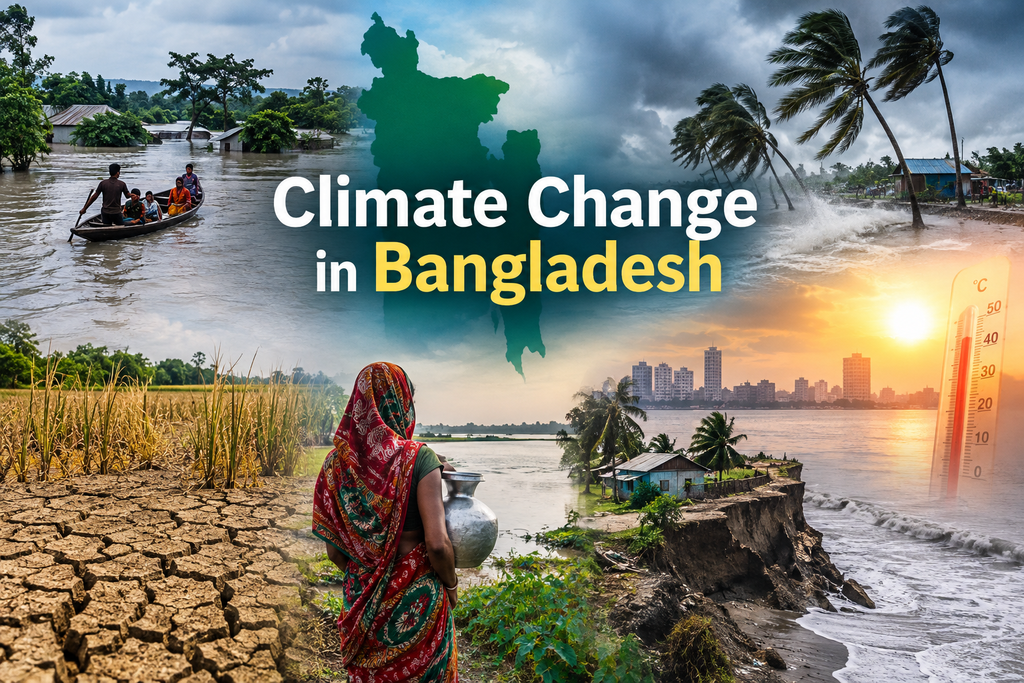
Climate-related migration can createClimate Change in Bangladesh additionalClimate Change pressure on cities. Rapid population growth may increase demand for housing, water, sanitation, transportation, healthcare, and employment.
For this reason,Climate Change in Bangladesh climate adaptationClimate Change should not focus only on rural areas. Urban planning and social protection are also important components of climate resilience.
Vulnerable Areas of Bangladesh
Different parts of Bangladesh face different climate risks.
Coastal Areas
Table of Contents
Coastal districts faceClimate Change in Bangladesh risks from cyclones, storm surges, sea-level rise, coastal erosion, and saltwater intrusion. Communities dependent on agriculture and fisheries can be particularly vulnerable.
Riverine AreasClimate Change in Bangladesh
Communities near major rivers can experience flooding and riverbank erosion. People may loseClimate Change in Bangladesh farmland and homes when river channels change.
Haor RegionsClimate Change in Bangladesh
The haor areas of northeastern Bangladesh areClimate Change vulnerable to flash floods, particularly during the agricultural season. Sudden flooding can damage crops and threaten household income.
Urban AreasClimate Change in Bangladesh
Cities face challenges such as extreme heat,Climate Change in Bangladesh waterlogging, drainage problems, and pressure on publicClimate Change in Bangladesh infrastructure. Better urban planning can reduce some of these risks.
Climate Change and Education
Climate change can affect education inClimate Change in Bangladesh several ways. Floods and cyclones may damage schools or prevent students from attending classes. Families experiencing economic hardship may also struggle to keep children in school.
Schools can play an important role in climate education and disaster preparedness. Students can learn about environmental protection, emergency response, water conservation, Climate Change and sustainable lifestyles.
Climate-resilient schools can also serve as community facilities during emergencies when appropriate.
Climate-Smart Agriculture in Bangladesh
Climate-smart agriculture can help farmers adapt to changing environmental conditions whileClimate Change improving productivity and resource efficiency.
Potential approaches include:
- Using flood-tolerant and drought-tolerant crop varieties
- Improving irrigation efficiency
- Practicing crop diversification
- Using weather and climate information
- Improving soil management
- Developing floating agriculture where suitable
- Strengthening agricultural extension services
- Improving storage and post-harvest management
The most suitable approach depends on local conditions, including soil, water availability, climate risks, and farmers’ resources.
Role of Renewable
Renewable energy can support Bangladesh’s efforts to develop a lower-carbon energy system. Solar power has particular potential because sunlight is widely available and solar technologies can be deployed at different scales.
Solar systems can support households, businesses, agricultural operations, schools, and other facilities. Expanding clean energy can also help reduce dependence on fossil fuels while supporting energy access.
However, renewable energy development requires appropriate investment, infrastructure, financing, technical skills, and effective policies.
Role of the Sundarbans
The Sundarbans is one of Bangladesh’s most important natural ecosystems. This mangrove forest provides habitat for wildlife and supports the livelihoods of many coastal communities.
Mangrove ecosystems can also provide natural protection against coastal hazards. Their roots help stabilize sediments, while the wider ecosystem can reduce some of the impacts associated with waves and storms.
Protecting the Sundarbans is therefore important not only for biodiversity but also for climate resilience and sustainable development.
Government Initiatives for Climate Resilience
Bangladesh has developed policies and programs focused on climate adaptation, disaster risk reduction, environmental protection, and sustainable development.
Important areas of action include cyclone preparedness, early-warning systems, resilient infrastructure, coastal protection, climate-resilient agriculture, renewable energy, and disaster management.
Bangladesh has also developed national climate strategies and plans that recognize the need to integrate climate resilience into development planning.
Effective implementation, adequate financing, transparency, local participation, and long-term monitoring are important for ensuring that climate policies produce meaningful results.
International Cooperation
Climate change cannot be solved by one country alone. International cooperation is essential because greenhouse gas emissions and climate impacts cross national borders.
Bangladesh participates in international climate negotiations and works with development partners on adaptation, disaster management, renewable energy, environmental protection, and climate finance.
International climate finance can help vulnerable developing countries invest in resilient infrastructure and adaptation programs. Technology transfer and capacity building can also support long-term climate resilience.
How Bangladesh Can Build a Climate-Resilient Future
Building climate resilience requires action at multiple levels.
First, infrastructure should be designed to withstand future climate risks. Roads, bridges, drainage systems, schools, hospitals, and housing should consider changing environmental conditions.
Second, early-warning systems should continue to improve so that communities receive timely and understandable information before disasters.
Third, farmers need access to climate-resilient technologies, financing, training, and reliable weather information.
Fourth, natural ecosystems such as mangroves, wetlands, forests, and rivers should be protected and restored.
Finally, climate adaptation should be inclusive. Women, children, older people, people with disabilities, low-income households, and communities dependent on natural resources can face different levels of vulnerability and may require targeted support.
Frequently Asked Questions About Climate Change in Bangladesh
What are the main effects of climate change in Bangladesh?
Major climate-related risks include flooding, cyclones, sea-level rise, river erosion, salinity, extreme heat, changing rainfall patterns, and impacts on agriculture, water resources, health, and livelihoods.
Why is Bangladesh vulnerable to climate change?
Bangladesh is vulnerable because of its low-lying geography, extensive river systems, long coastline, high population density, and dependence on climate-sensitive sectors such as agriculture and fisheries.
How does climate change affect agriculture in Bangladesh?
Climate change can increase risks from floods, droughts, heat, salinity, and irregular rainfall. These conditions can affect crop yields, livestock, fisheries, and farmers’ incomes.
How can Bangladesh reduce climate change impacts?
Bangladesh can reduce climate risks through stronger disaster preparedness, climate-resilient infrastructure, sustainable agriculture, renewable energy, ecosystem conservation, improved water management, and effective climate policies.
What can ordinary people do about climate change?
Individuals can reduce unnecessary energy use, minimize waste, conserve water, protect trees, use environmentally responsible transportation where practical, and learn about local disaster-preparedness measures.
Is Bangladesh responsible for global climate change?
Bangladesh’s contribution to global greenhouse gas emissions is relatively small compared with major historical and current emitters. However, Bangladesh is highly exposed to many climate-related impacts.
Final Thoughts
Climate change in Bangladesh is not simply an environmental issue. It is closely connected to food security, public health, economic development, poverty reduction, migration, education, infrastructure, and social resilience.
The country’s experience demonstrates why climate adaptation and sustainable development need to progress together. Protecting vulnerable communities while expanding economic opportunities requires long-term planning and cooperation between government institutions, local communities, businesses, researchers, and international partners.
With appropriate investment, innovation, effective policies, and community participation, Bangladesh can strengthen its ability to cope with climate risks while continuing its development journey. Climate resilience should therefore remain an important part of Bangladesh’s environmental, economic, and social planning.
Leave a Reply